Cursor vs Jira: The Harness Wins
I ran the same experiment on Cursor and Jira's Rovo AI: analyze a set of Jira tickets, and give me a report.
Here's what happened:
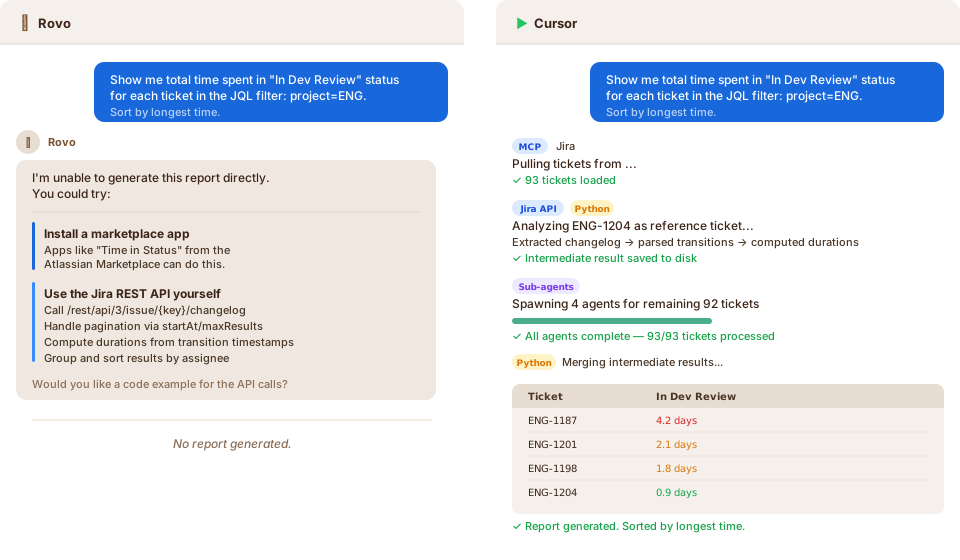
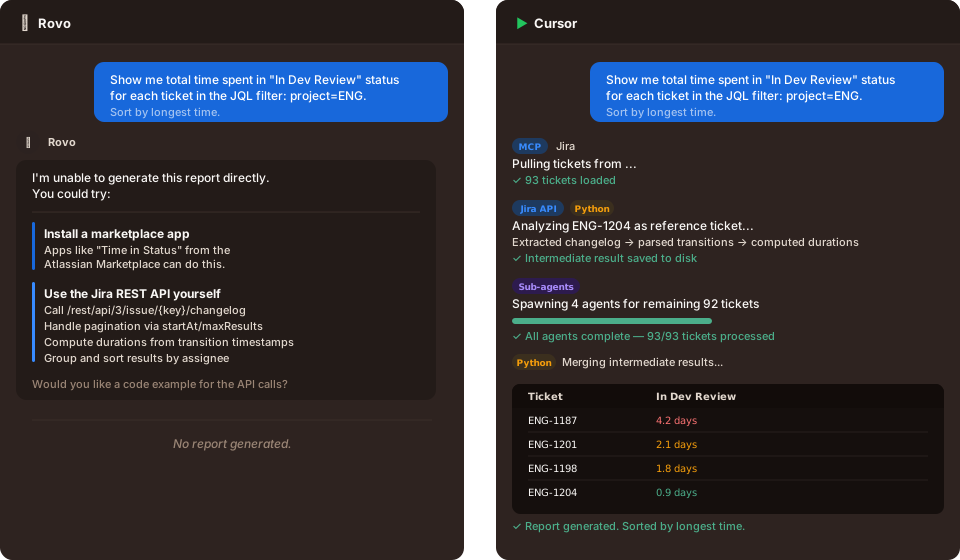
Same prompt. Same tickets. Completely different outcomes.
Rovo told me it can't generate the report directly. It suggested two "workarounds": install a third-party marketplace app ("Time in Status"), or go write Jira REST API calls myself. It even laid out the API endpoints, pagination logic, and changelog extraction steps — for me to implement. The AI gave me a homework assignment.
Cursor, on the other hand, pulled every ticket via MCP, picked one as a reference to validate its approach, then spawned sub-agents to process the full backlog in parallel. It wrote Python to extract changelogs, compute durations, and merge intermediate results — and handed me a finished report sorted by longest time.
The gap has nothing to do with which LLM is smarter. It has everything to do with the harness.
Agent = Model + Harness
The harness is everything except the model: tool execution, file system access, code runtime, sub-agent orchestration, memory, state management, error recovery. The model is the brain. The harness is the body. A brain in a jar can think, but it can't do anything.
Jira's Rovo AI is a brain in a jar. It can read your tickets and summarize them. But when you ask it to actually compute something — like time-in-status — it suggests you install a marketplace app or write API scripts yourself. No file system. No code execution. No ability to spawn workers for parallel processing. It operates within the tight walls of Jira's UI.
Cursor can read files, write code, execute it, check the output, branch into sub-agents when the workload demands it, and persist results to disk. That's the difference between a chatbot and an agent.
What the Harness Actually Gives You
Three primitives that made the difference:
File system access. The agent can read data, write intermediate results, and persist outputs. It doesn't have to hold everything in context. It can offload work to disk, come back to it, and build up complex artifacts incrementally.
Code runtime. Instead of the model guessing at analysis, it writes code to compute the answer. When I asked Cursor to find the time spent in a status, it didn't eyeball them — it wrote a script, and surfaced programmatically verifiable results. The model reasons about what code to write. The runtime gives it ground truth.
Sub-agent orchestration. When you have 93 tickets and each one needs a multi-step processing pipeline, a single agent context window isn't enough. Cursor spins up child agents, each handling a subset, then merges the results. Parallelism for free.
Strip any one of these away and you get a dramatically worse product. Strip all three and you get Rovo handing you a REST API tutorial instead of a report.
Bonus: Let Users Create Reusable Artifacts
Here's the thing that really got me: after Cursor produced my ticket analysis report, I asked it to write the code as a standalone script. Now I can run that same analysis next week. No LLM tokens. No LLM calls. Just a Python script that produces the exact same report structure.
The agent bootstrapped its own replacement for a recurring task.
If you're building AI products, this is a design principle worth internalizing: let users turn AI outputs into reusable artifacts. Scripts, saved workflows, rules, templates — anything that converts a one-off AI interaction into a predictable, repeatable process.
The best AI features aren't just smart. They help users build their own automation. The AI does the hard thinking once, then hands the user something they can run forever without the AI.
Rovo can't do this. There's no "save this analysis as a reusable workflow" because there's no code layer to save to.
The Pattern Worth Learning
Cursor, Claude Code — the AI tools that are actually changing how people work share the same architecture. They don't have proprietary models. They use the same foundation models everyone else does. What separates them is the harness: code execution, file system access, sub-agent orchestration, persistent state.
The model is a commodity. The harness is the product.
And the logical next step is obvious: take the harness beyond code. Cursor should launch Cursor Cowork — the same agent infrastructure applied to general knowledge work. Claude Code already did this with Claude Cowork. The harness pattern isn't limited to software engineering. It works anywhere you need an AI to do things, not just say things.
If you're shipping AI features, here's the thought experiment worth running: if you gave Cursor or Claude Code access to all your product's data — every ticket, every document, every metric — would it do a better job than the AI you've built?
If the answer is yes, the gap isn't the model. It's the harness. The patterns are right there — and they're yours to build on.
Where This Is Heading
Users are already migrating their analytical and agentic workflows out of domain-specific tools and into general-purpose harness products. We've seen this pattern before. Salesforce became the system of record — the place where data lived — but an entire ecosystem of tools emerged to do the actual work on that data. The CRM held the contacts; other products ran the campaigns, built the reports, and automated the workflows. Looker did the same to data warehouses — the warehouse stored the data, but Looker gave analysts the tools to actually compute, explore, and share insights from it.
The same split is happening with AI. Your product might be where the data lives. But if you don't give the AI a real harness to work with, users will pipe that data into tools that can compute, iterate, and build reusable artifacts from it. You don't want to become the system of record that everyone exports from.
The teams that figure this out first — the ones that build real harnesses with code execution, file systems, and sub-agent orchestration into their products — will pull away from everyone else.
The harness wins.